How Traumatic Brain Injuries Are Diagnosed: Tests and Scans
An overview of the current best practices for accurate diagnosis and categorization of TBI — and where to turn for expert legal help.
Request our Free Book on Traumatic Brain Injury
In the last two decades, there have been dramatic advancements in the way traumatic brain injuries (TBIs) are diagnosed. Medical research has led to the development of improved diagnostic tools, testing methods, and standardized guidelines.
Evidence-based medicine — using the best available knowledge from clinical studies and real-world medical practice — guides today’s diagnostic approaches.
Sources:
- N. Carney et al, “Guidelines for the Management of Severe Traumatic Brain Injury, Fourth Edition,” Neurosurgery 80, no. 1 (2017): 6.
- D. Godoy et al, “Potentially Severe (Moderate) Traumatic Brain Injury,” Critical Care Medicine 48, no. 12 (2020): 1851.
Evaluation in the Emergency Department
When facing a potential TBI diagnosis, it is important to understand that not all hospitals are created equally. Some hospitals are not prepared to treat life-threatening brain injuries because they do not have the necessary medical specialists and equipment. EMTs or paramedics typically decide where to transport the patient after assessment. Patients with a moderate to severe brain injury should be transported to a hospital that has a trauma center, if possible.
A trauma center is a unit, typically within an emergency department, where neurosurgeons and other medical specialists treat patients with life-threatening conditions. Medical studies support the fact that treatment in trauma centers increases the likelihood of better outcomes for people with moderate to severe TBI. There are distinct levels of trauma centers, typically graded from highest (Level I) to lowest (Level IV). Trauma center designation is a process outlined and developed at the state and local level, and the process can vary from state to state.
A Level I trauma center is a regional resource that provides the highest level of medical and surgical care. There can be both adult and pediatric trauma centers. A Level I center provides full treatment from emergencies through rehabilitation. It has a full roster of specialists available 24/7 (including neurosurgery, orthopedic surgery, critical care/trauma surgery, anesthesiology, emergency physicians, radiologists, internal medicine/hospitalists, plastic surgeons, oral and maxillofacial surgeons, physical and medical rehabilitation, and various specialized therapists). Level I facilities must meet many requirements, including certain equipment that must be available; a certain number of surgeons and anesthesiologists that must be on duty; and a quality assessment program. It must also meet the minimum requirements for treating severely injured patients. Often a Level I center is affiliated with a medical school at a facility known as a teaching hospital, with ongoing research and surgical residency programs. A Level I center can serve as a referral resource for hospitals in nearby communities.
Some Level I trauma centers have dedicated neurocritical care or trauma-intensive care units (a Neuro ICU). A Neuro ICU is the highest level of care available for TBIs. Not all Level I trauma centers have a Neuro ICU. If a Level I or II trauma center does not have a Neuro ICU, it must at a minimum have a combined medical-surgical ICU.
A Level II trauma center can initiate care, but a Level I trauma center supports a Level II center. A Level II has some but not all the specialists that are available at a Level I institution. Level II facilities provide 24/7 service, but they do not require ongoing medical research or a surgical residency program.
A Level III trauma center has transfer agreements in place for patients requiring more comprehensive care at a Level I or II center. It does not have all the necessary specialists and usually transfers patients to a Level I or II trauma center. It provides backup resources to rural or community hospitals in case of severe injuries. Level IV centers stabilize and then transfer patients to higher-level trauma centers.
Physicians may need to transfer TBI patients to receive appropriate care, but transfers take time — and time is critical in the treatment of moderate or severe TBI. However, it is important to be at a hospital equipped and prepared to give the best possible treatment. Medical research confirms that treatment in hospitals with neurosurgical support and specialized, multidisciplinary treatment (especially those with a neurointensive ICU that follows evidence-based medicine and guideline-driven protocols) is associated with better patient outcomes.
Sources:
- D. Lundy et al, “Trauma Systems in North America,” OTA international: The Open Access Journal of Orthopaedic Trauma 2, no. Suppl. 1 (2023).
- J. J. Tepas III, E. E. Pracht, B. L. Orban, and L. M. Flint, “High-Volume Trauma Centers Have Better Outcomes Treating Traumatic Brain Injury,” The Journal of Trauma and Acute Care Surgery 74, no. 1 (2013): 143.
Diagnostic Evaluation in the Emergency Department
When a patient arrives at the emergency department with a suspected moderate or severe TBI, physicians follow the Advanced Trauma Life Support (ATLS) protocol to rapidly assess injuries and identify the nature and severity of potential brain trauma.
The American College of Surgeons developed the ATLS protocol to manage trauma patients effectively and efficiently, and the goal of the protocol is to provide timely and comprehensive care.
Sources:
- ATLS Subcommittee, American College of Surgeons’ Committee on Trauma, and International ATLS Working Group, “Advanced Trauma Life Support (ATLS): The Ninth Edition,” Journal of Trauma and Acute Care Surgery 74, no. 5 (2013): 1363.
- Brain Trauma Foundation, “Guidelines for the Management of Severe Traumatic Brain Injury,” Journal of Neurotrauma 24, no. 1 (2007): S7.
Key Diagnostic Components
Following the ABCDE approach (Airway, Breathing, Circulation, Disability, Exposure), the physician conducts an examination to assess and stabilize life-threatening conditions. Vital signs are monitored. In the case of a severe brain injury, airway management and breathing support are prioritized to ensure adequate oxygenation and ventilation.
A complete blood count, electrolytes, glucose, coagulation parameters, blood alcohol level, and urine toxicology are checked. Efforts to reverse any bleeding disorder (coagulopathy) should begin immediately.
A neurologic examination is performed to evaluate the patient’s level of consciousness, the involuntary response of the pupil of the eye to light, motor function, and signs of developing pressure on the brain known as increased intracranial pressure (ICP), such as a low heart rate, irregular respirations, and a widened pulse pressure. This assessment helps determine the severity of the brain injury.
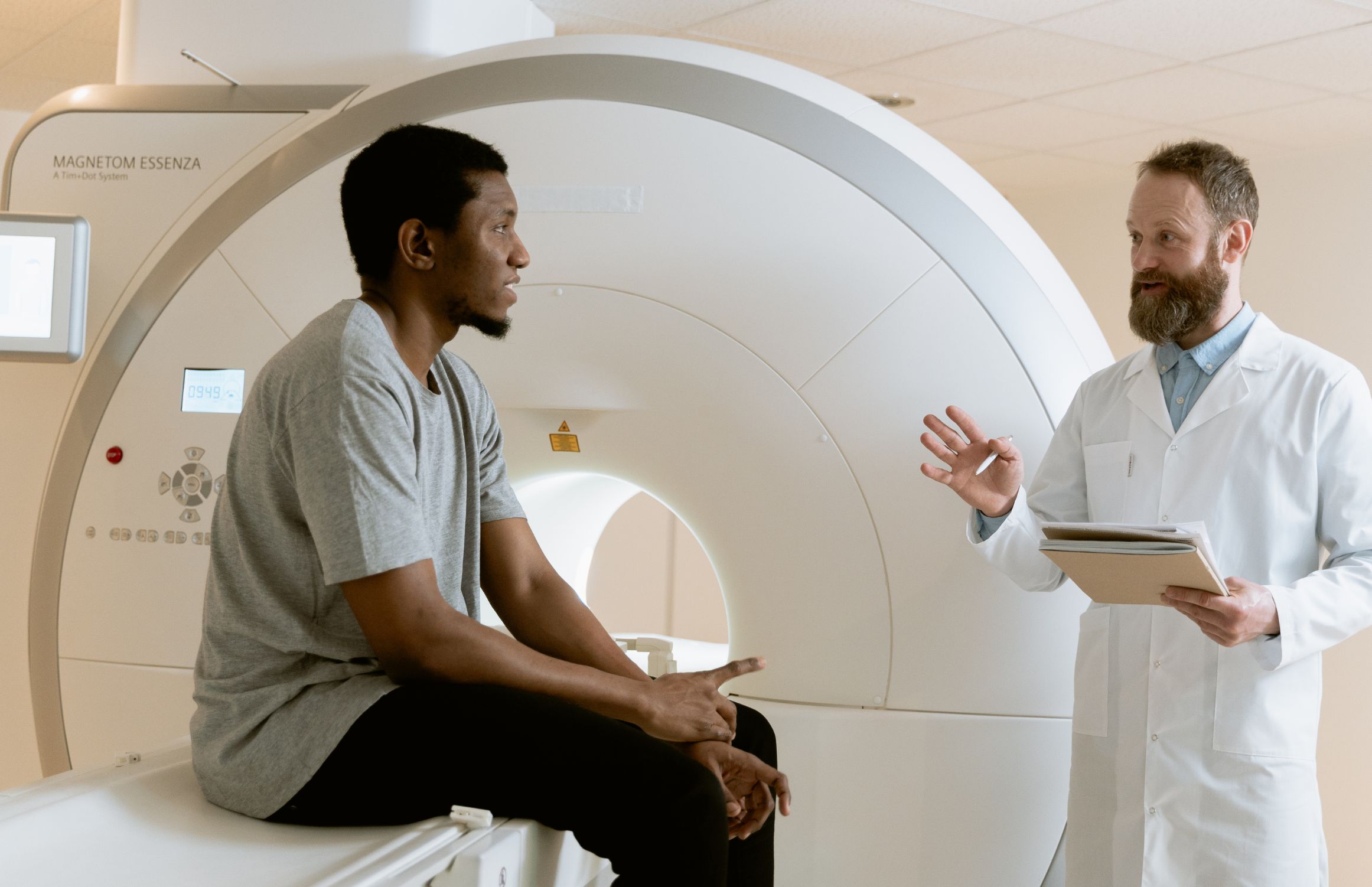
A CT scan of the head may be ordered to assess the existence and extent of the brain injury, identify brain bleeding (intracranial hemorrhage), or detect other injuries that require timely intervention. A CT scan is the preferred type of imaging in the first few hours following a brain trauma (known as the acute phase), and it should be performed as quickly as possible in patients with moderate and severe TBI because certain damaged areas (lesions) may indicate the need for potentially lifesaving neurosurgery. A CT scan will detect skull fractures, intracranial hematomas (localized bleeding), and cerebral edema (swelling caused by fluid retention).
ICP is a rise in the pressure within the brain and is potentially life-threatening. This can cause a secondary brain injury. The most common symptoms of increased ICP are headache, blurred vision, confusion, high blood pressure, shallow breathing, vomiting, changes in behavior, weakness, or problems with moving or talking. In cases of suspected severe brain injury, a pressure monitor may be placed inside the head by a neurosurgeon. The monitor device detects pressure inside the skull and sends the test results to the medical team. The physicians use this information to make treatment decisions, including whether emergency surgery is required.
When a patient has clinical signs of impending or ongoing high pressure within the skull (cerebral herniation), immediate lifesaving measures are required. The clinical signs of cerebral herniation include: (1) concerning results of the examination of the pupils of the eyes (pupillary asymmetry or unilateral or bilateral fixed and dilated pupils); (2) concerning patterns of involuntary body position where the patient has involuntary extension (increased angle that straightens joints) or flexion (a decreased angle that bends the joints) of the neck, torso, arms, and legs (decorticate or decerebrate posturing); (3) difficult breathing (respiratory depression); and (4) the “Cushing triad” of three worrisome symptoms: high blood pressure (hypertension), a slow heart rate (bradycardia), and irregular breathing (respiration).
Early screening for blunt injuries to the arteries in the neck (the carotid or vertebral arteries), which supply blood and oxygen to the brain, is required. This rare injury, known as blunt cerebrovascular injury (BCVI), can cause a damaging stroke due to blocked or reduced blood flow to the brain (ischemic stroke). Early diagnosis and treatment are critical to minimizing complications from BCVIs. The medical team should continue to closely monitor the patient for potential BCVI during the hospitalization because it can develop after the first few hours or days.
Depending on the severity of the injury, in the ED the neurosurgical consultation and procedures or surgery may be recommended (discussed later in this article). Placement of increased intracranial pressure (ICP) monitoring devices may also be indicated.
Upon arrival in the emergency department, the medical team can take steps to minimize further damage to the brain (called neuroprotective measures), including maintaining adequate oxygen flow to the brain (cerebral perfusion pressure), preventing high and low blood pressure, and controlling seizures.
Patients in the ED also need to be assessed for other traumas (Spinal Cord Injury, broken bones, and other internal injuries), per the ATLS protocol.
Close monitoring of the patient’s neurologic status, vital signs, and response to interventions is required to detect changes promptly and adjust the treatment plan as needed.
In cases of moderate to severe brain injury requiring specialized surgical or critical care, timely transfer to a higher level of care facility equipped to provide advanced interventions may need to be arranged to optimize outcomes.
Sources:
- R. Cadena, M. Shoykhet, and J. J. Ratcliff, “Emergency Neurological Life Support: Intracranial Hypertension and Herniation,” Neurocritical Care 27, No. Suppl. 1 (2017): 82.
- W. L. Biffl et al, “Treatment-Related Outcomes from Blunt Cerebrovascular Injuries,” Annals of Surgery 235, no. 5 (2002).
- Brain Trauma Foundation, “Guidelines for the Management of Severe Traumatic Brain Injury,” Journal of Neurotrauma 24, no. 1 (2007): S7.
Other TBI Diagnostic Tools: The Glasgow Coma Scale and the Rancho Los Amigos Scale
The medical team needs a way to assess cognitive injuries and recovery. Two of the most widely used ways to do this are the Glassgow Coma Scale (GCS) and the Rancho Los Amigos Level of Cognitive Functioning Scale (RLAS).
Sources:
- G. Teasdale and B. Jennett, “Assessment of Coma and Impaired Consciousness: A Practical Scale,” The Lancet 7872, no. 2 (1974): 81.
- D. A. Godoy et al, “Moderate Traumatic Brain Injury: The Grey Zone of Neurotrauma,” Neurocritical Care 25, no. 2 (2016): 306.
Rancho Los Amigos Level of Cognitive Functioning Scale (RLAS)
On the other hand, the RLAS is a widely used tool for assessing cognitive recovery from a TBI. Developed in 1972, physicians use this 10-level scale by observation of TBI patient behaviors, including their cognitive level during various phases of recovery.
The RLAS assesses cognitive and behavioral patterns during recovery using a 10-level scale ranging from:
- Level I: No response
- Level X: Independent functioning with effective judgment and multitasking
Although both scales are widely used, they have limitations. For example, it is not possible to use the GCS when someone is on a ventilator or does not speak the same language as the health care provider. Furthermore, they are not the only tools practitioners use to make a TBI diagnosis or predict long-term consequences. They are part of — but not substitutes for — a full diagnostic workup that includes imaging, physical exams, and neurological assessments.
Understanding the Long-Term Implications of a TBI Diagnosis
As they prepare for the next stages of treatment and recovery, it is important for the patient (as able), family, and the medical team to discuss the patient’s diagnosis, current medical condition, treatment plan, and prognosis. Families must ask direct questions, including:
- What does this TBI diagnosis mean in the long and short term?
- What cognitive recovery progress has been made, and what does that mean?
- What further treatment, surgery, and care will be required?
- What alternative treatment or care is available?
- Will the insurance pay for the treatment required?
The medical team must speak clearly, not in medical jargon, in terms the patient and family understand. And the family should not allow the conversation to end until their questions are answered.
Need help investigating your legal rights related to a TBI?
Speak to an experienced brain injury attorney team like Cohen, Placitella & Roth.
For five decades, CPR has successfully represented individuals and families in TBI cases nationwide working with qualified co-counsel.

Get Our Free Traumatic Brain Injury Book
To learn more about Traumatic Brain Injury request our comprehensive book, available for free directly to your inbox